

 Posts
Posts


Sunday, December 21, 2025


More of this
Thanks to Rick Steves, Lynnwood Hygiene Center has a permanent home
“I’m going on my second year here,” Gillins said. “If this place wasn’t here I don’t know how I would’ve survived.”
The hygiene center has provided more than 50,000 showers to people experiencing homelessness and housing insecurity since it opened in 2020. Guests can eat a hot meal and have access to clothing, essential needs and case management services.
article
Saturday, December 20, 2025
Today's Poem by Carrie Shiper
|
|
|
Friday, December 19, 2025
Two Cans of Tomato Paste on a Bridge
I found two unopened cans of tomato paste on a bridge in the park. They weren't even dented! I found them on my walk with my dog Romeo the other morning. They won't expire for two years. They had snow and ice and dirt on the outside but I pocketed them and ran them under hot water when I got home. Now they are dry and in the cupboard. This morning my sidewalk was covered in dried chick peas. As I was sweeping up I found the remains of the one-pound bag on my garden steps. It saddens me that the food items given out to the homeless are often impossible to eat without pots and pans and can openers, not to mention a home.
Tuna, Pickle, and Potato Chips
:format(webp)/www.instacart.com/assets/domains/product-image/file/large_810c16de-3e9a-4528-915e-fc48b86da598.png)
Once in a BLUE MOON I want potato chips with tuna fish and a pickle and pickle juice to drink! Today was such a day. I had no idea there were so many kinds of potato chips including unsalted Price Rite brand. Perfect. Sometimes following a craving is the right thing to do.
Then I took advantage of the pouring rain and raked the leaf debris off of my sidewalk into the gushing gutter river on my street. I know it's not the right way and slightly naughty but I did it to take advantage of the moment.
Another Green Soup
I bought two bok choy bunches rinsed and chopped into one or two inch chunks, two bunches of kale rinsed and chopped including stems if they are young, three medium/large white and red onions sliced, four to six large carrots chopped into coins, about 3/4 cup of miso paste, 1 cup of jug Chianti, generous bloops of olive oil, some chicken bullion powder, splashes of soy sauce, 4 cloves of garlic smashed and chopped. I put it all in the instant pot (pressure cooker) with ample amount of water to make it be a soup and cooked it for 2 minutes. We had cooked leftover Italian hot sausage and chopped it small and sprinkled it in and we had leftover brown rice that we added in too. We love soup. Oh, and I added pickle juice too. Enjoy.
Pizzelle are indeed small, flat and round
(We'll use the name "pizzelle" in this article for both singular and plural--singular is actually pizzella). "Pizze" is from the Italian word for "round" and "flat" (pizze)--yes, just like the word pizza. The "elle" ending means small. Pizzelle are indeed small, flat and round. source
Parking Lot
After my swim yesterday I drove to Price Rite to get greens for soup. In the parking lot I noticed a gaunt woman with protruding cheekbones and a gray pallor. She was with her teenage son. She has that extreme Woonsocket poverty look, I thought to myself. Her son seemed dejected too. He was wearing a dark blue hoodie. As I approached the store entrance I noticed an unopened package of Price Rite brand hot dogs on the ground. I picked it up, turned around, and walked back into the parking lot. I asked a woman near her car, are these yours? No, I just got here. Then I looked for the woman and her son. They were seated in their small beat-up car, just about to drive away, when I knocked on the passenger side window. The woman in the driver's seat visibly jumped. I said, Are these yours? She lowered the window and reached over. Oh yes, she said, God bless you!
Thursday, December 18, 2025
a ville non-sexiste, or non-sexist city
Nantes is trailblazing the way to safer, less discriminatory urban life.
“We couldn’t wait for change anymore, we had to take action,” says Mahaut Bertu, the deputy mayor of Nantes in charge of equality, the fight against discrimination and the non-sexist city project. “Femicides continue every year. Women suffer harassment every day. [To make change], we had to take a hold of the problem ourselves.”
https://reasonstobecheerful.world/nantes-france-non-sexist-city/
Wednesday, December 17, 2025
Tuesday, December 16, 2025
It’s a reminder that to make sense of, to be at peace with this world, we have to find some path of solace or redemption that can coexist even with the abject tragedy and sorrow. Josh Marshall
Monday, December 15, 2025
Leave the impurities in there
Leave things lumpy. People want to know how the protagonist’s father’s dress socks looked against his pale white shins. People want to know the titles of the strange and eclectic books lining the walls of his study. People want to know the sounds he made while snoring, how he looked while concentrating, the way his glasses pinched the bridge of his nose, leaving what appeared to be uncomfortable-looking ovals of purple and red discolored skin when he took those glasses off at the end of a long day. Even if those lumps make the mixture less smooth, less pretty, even if you don’t quite know what to do with them, even if they don’t figure into your chemistry—they don’t have a place in the reaction equations—leave them there. Leave the impurities in there. Charles Yu
Sunday, December 14, 2025
Holiday Swim Hours Franklin MA YMCA
Christmas Eve Wed. Dec. 24: 5:30 am - 2:00 pm
Christmas Day Thurs. Dec. 25: Closed
New Year's Eve Wed. Dec. 31: 5:30 am - 2:00 pm
New Year's Day Thurs. Jan 1: 10:00 am - 1:00 pm
Saturday, December 13, 2025
The only thing that makes one an artist is making art. David Rakoff
It's rare that I'm not at work on some sort of craft project. I've often enthused about the need to make things; how it employs a unique set of muscles - physical, intellectual, spiritual - that I can attain a state of flow when making something that I almost never can when writing.
David Rakoff
Delicious Big Green Soup with Italian and Chinese accents
I love soup because it's friendly even when it has scary sausage meat in it, (says the former vegetarian). But I love to occasionally use meat as a spice mixed with a jillion vegetables like in Asian cooking.
I had a fridge full of freshly purchased produce and a bunch of leftovers. This is what I did.
I rinsed and chopped two bunches of bok choy, I added 2 jars of bean stock saved from this week's home cooked chick peas and kidney beans and I had some leftover stock from this week's pressure cooked spaghetti squash.
I added 3 or 4 cups of leftover cooked Basmati brown rice, 3-4 cups of cooked kidney beans, 1-2 cups of cooked spaghetti squash.
Then I rinsed and chopped 3 bunches of kale (to shrink it) and cooked them for 5 minutes in my huge Instant pot with a dozen Paisano brand Hot Italian sausage links (from Price Rite), about 3 lb.
Then I added the cooked kale and sausage links to the big soup pot on the stove.
I added a few tablespoons of Maggi brand powdered chicken bullion, many generous bloops of olive oil, a whole knob of ginger, and a good amount of Chianti. I smashed and peeled a whole bulb of garlic and added it to the soup pot. Then I let it all simmer.
Toward the end of the simmer I decided to add a pound of cooked chick peas that I had cooked yesterday, originally intended for making hummus.
I also added the fresh lemon juice leftover from making hummus last time - a good addition. Then I added quite a lot of soy sauce. And for color and sweetness I peeled 4 carrots into ribbons and added them. The carrots were like orange noodles.
It's a fantastic soup!
“He was ferocious about giving people opportunity — especially creatively — in the city," he said, and “fought for a lot of people’s ability to write and publish or edit and do whatever on a larger stage.”
Jeff Lawrence: My grandmother died, and she left my father some money. I got $40 grand. So I went swimming at the Somerville YMCA—I love to swim—and then afterwards, I was sitting in a hot tub. I was still really trying to find my place in this world in my mid-20s, and was like, “I need to do something.” Shovel had become successful insofar as people were calling me up and buying ads, but I had no clue in terms of publishing. I had a background in journalism and working for a college newspaper, but I didn’t know the inner-workings. I don’t have a degree in business. But all of a sudden it just hits me; “The fucking Phoenix has no competition! I need to start a weekly!”
The Dig, which folded in 2023, once boasted an all-star lineup of up-and-coming writers over the years, including authors Luke O’Neil, Baratunde Thurston, Michael Brodeur (a former Globe staffer who’s now a classical music critic at The Washington Post), and Chris Faraone, now the editorial director of the Boston Institute for Nonprofit Journalism. source
Friday, December 12, 2025
Sunlight
by Seamus Heaney
For Mary Heaney
There was a sunlit absence.
The helmeted pump in the yard
heated its iron,
water honeyed
in the slung bucket
and the sun stood
like a griddle cooling
against the wall
of each long afternoon.
So, her hands scuffled
over the bakeboard,
the reddening stove
sent its plaque of heat
against her where she stood
in a floury apron
by the window.
Now she dusts the board
with a goose's wing,
now sits, broad-lapped,
with whitened nails
and measling shins:
here is a space
again, the scone rising
to the tick of two clocks.
And here is love
like a tinsmith's scoop
sunk past its gleam
in the meal-bin.
__________
From North, Farrar, Straus and Giroux, 1985.
Thursday, December 11, 2025
Build a bowl of soup!
We took leftover brown rice, kale, squash, beans and liquid from home cooked beans and added drops of sesame oil and soy sauce to build a bowl of soup!
Skating Away
While families often get the rinks for their kids to enjoy, the parents enjoy them, too. White admits he finds peace on the rink after a long day.
“I go out there when my kids go to bed and skate around for an hour,” said White. “My wife’s like, ‘You’re really going out there by yourself right now?’ I’m like, ‘Yeah, gotta do it!”
“We must become so alone, so utterly alone, that we withdraw into
our innermost self. It is a way of bitter suffering. But then our
solitude is overcome, we are no longer alone, for we find that our
innermost self is the spirit, that it is God, the indivisible. And
suddenly we find ourselves in the midst of the world, yet undisturbed by
its multiplicity, for our innermost soul we know ourselves to be one
with all being.”
―
“When someone seeks," said Siddhartha, "then it easily happens
that his eyes see only the thing that he seeks, and he is able to find
nothing, to take in nothing because he always thinks only about the
thing he is seeking, because he has one goal, because he is obsessed
with his goal. Seeking means: having a goal. But finding means: being
free, being open, having no goal.”
“For me, trees have always been the most penetrating preachers. I revere them when they live in tribes and families, in forests and groves. And even more I revere them when they stand alone. They are like lonely persons. Not like hermits who have stolen away out of some weakness, but like great, solitary men, like Beethoven and Nietzsche. In their highest boughs the world rustles, their roots rest in infinity; but they do not lose themselves there, they struggle with all the force of their lives for one thing only: to fulfill themselves according to their own laws, to build up their own form, to represent themselves. Nothing is holier, nothing is more exemplary than a beautiful, strong tree. When a tree is cut down and reveals its naked death-wound to the sun, one can read its whole history in the luminous, inscribed disk of its trunk: in the rings of its years, its scars, all the struggle, all the suffering, all the sickness, all the happiness and prosperity stand truly written, the narrow years and the luxurious years, the attacks withstood, the storms endured. And every young farmboy knows that the hardest and noblest wood has the narrowest rings, that high on the mountains and in continuing danger the most indestructible, the strongest, the ideal trees grow.
Trees are sanctuaries. Whoever knows how to speak to them, whoever knows how to listen to them, can learn the truth. They do not preach learning and precepts, they preach, undeterred by particulars, the ancient law of life.
A tree says: A kernel is hidden in me, a spark, a thought, I am life from eternal life. The attempt and the risk that the eternal mother took with me is unique, unique the form and veins of my skin, unique the smallest play of leaves in my branches and the smallest scar on my bark. I was made to form and reveal the eternal in my smallest special detail.
A tree says: My strength is trust. I know nothing about my fathers, I know nothing about the thousand children that every year spring out of me. I live out the secret of my seed to the very end, and I care for nothing else. I trust that God is in me. I trust that my labor is holy. Out of this trust I live.
When we are stricken and cannot bear our lives any longer, then a tree has something to say to us: Be still! Be still! Look at me! Life is not easy, life is not difficult. Those are childish thoughts. Let God speak within you, and your thoughts will grow silent. You are anxious because your path leads away from mother and home. But every step and every day lead you back again to the mother. Home is neither here nor there. Home is within you, or home is nowhere at all.
A longing to wander tears my heart when I hear trees rustling in the wind at evening. If one listens to them silently for a long time, this longing reveals its kernel, its meaning. It is not so much a matter of escaping from one's suffering, though it may seem to be so. It is a longing for home, for a memory of the mother, for new metaphors for life. It leads home. Every path leads homeward, every step is birth, every step is death, every grave is mother.
So the tree rustles in the evening, when we stand uneasy before our own childish thoughts: Trees have long thoughts, long-breathing and restful, just as they have longer lives than ours. They are wiser than we are, as long as we do not listen to them. But when we have learned how to listen to trees, then the brevity and the quickness and the childlike hastiness of our thoughts achieve an incomparable joy. Whoever has learned how to listen to trees no longer wants to be a tree. He wants to be nothing except what he is. That is home. That is happiness.”
― Bäume: Betrachtungen und Gedichte
it’s important that democracy is defended at every turn
“Authoritarian systems give the appearance of performing, but their solutions are not thorough, they are not sustainable, and they are not fair,” she went on. “They will decay because the way they function is to exclude, abuse, and allow massive corruption.”
But she says she’s also learned to never underestimate the autocrat.
Whether it’s undermining the judiciary or intimidating local governments, “In many cases, you think, ‘No, they won’t do it,’” she says. “But we have seen how [centralization of power] has advanced very quickly. So it’s important that democracy is defended at every turn,” she said.
Wednesday, December 10, 2025
Pizzelle Recipe from a Bakery
Original Recipe
| One-Third Quantity | |
|---|---|
| 1 dozen eggs | 4 eggs |
| 3 cups of sugar | 1 cup of sugar |
| 2 cups of vegetable oil | ⅔ cup of vegetable oil |
| 1 ½ teaspoons Anise oil | ½ teaspoon Anise oil |
| 6 cups of flour | 2 cups of flour |
| ½ teaspoon salt | ⅙ teaspoon salt |
Instructions
- Blend eggs and sugar until smooth.
- Add in flour and salt, blend well.
- Add in oil and Anise oil and blend well.
- Let the batter sit for 6 hours or overnight in your refrigerator, covered, to allow flavors to blend.
- Make your Pizzelles according to your Pizzelle iron's instruction.
- Choose how crispy you enjoy them
- Remove each pizzelle from your pizzelle iron with a small spatula, and place on wire cooking rack until cooled and crisped up.
- Store in a sealed container, cookie jar, tin or plastic bag. Do not store them in the same container with other cookies or they will soften.
Tuesday, December 09, 2025
“Breathing in, I calm body and mind. Breathing out, I smile.
Dwelling in the present moment I know this is the only moment.”
― Being Peace
― Being Peace
“Feelings come and go like clouds in a windy sky. Conscious breathing is my anchor.”
―
Stepping into Freedom: An Introduction to Buddhist Monastic Training
“People have a hard time letting go of their suffering. Out of a fear of the unknown, they prefer suffering that is familiar.”
―
“Letting go gives us freedom, and freedom is the only condition
for happiness. If, in our heart, we still cling to anything - anger,
anxiety, or possessions - we cannot be free.”
― The Heart of the Buddha's Teaching: Transforming Suffering into Peace, Joy, and Liberation
― The Heart of the Buddha's Teaching: Transforming Suffering into Peace, Joy, and Liberation
Fear keeps us focused on the past or worried about the future. If we can acknowledge our fear, we can realize that right now we are ok. Right now, today, we are still alive. Our bodies are working marvelously; our eyes can still see the beautiful sky. Our ears can still hear the voices of our loved ones.
Thich Nhat Hanh
...in the social action, don’t do anything that you do with negativity, frustration, or anger. Because that will rile the opposition. Do your social action with love.
https://beherenownetwork.com/ram-dass-now-ep-105-keeping-quietness-love-2017-transcript/
When you go out into the woods, and you look at trees, you see all these different trees. And some of them are bent, and some of them are straight, and some of them are evergreens, and some of them are whatever. And you look at the tree and you allow it. You see why it is the way it is. You sort of understand that it didn’t get enough light, and so it turned that way. And you don’t get all emotional about it. You just allow it. You appreciate the tree.
The minute you get near humans, you lose all that. And you are constantly saying ‘You are too this, or I’m too this.’ That judgment mind comes in. And so I practice turning people into trees. Which means appreciating them just the way they are.
―
A book lying idle on a shelf is wasted ammunition. Like money, books
must be kept in constant circulation... A book is not only a friend, it
makes friends for you. When you have possessed a book with mind and
spirit, you are enriched. But when you pass it on you are enriched
threefold.
―
The Books in My Life
Excerpted from BE LOVE NOW by Ram Dass
You’re being loved even more than your mother loved you when you were an infant, more than you were ever loved by your father, your child, or your most intimate lover—anyone. This lover doesn’t need anything from you, isn’t looking for personal gratification, and only wants your complete fulfillment.
You are loved just for being who you are, just for existing. You don’t have to do anything to earn it. Your shortcomings, your lack of self-esteem, physical perfection, or social and economic success— none of that matters. No one can take this love away from you, and it will always be here.
Imagine that being in this love is like relaxing endlessly into a warm bath that surrounds and supports your every movement, so that every thought and feeling is permeated by it. You feel as though you are dissolving into love.
This love is actually part of you; it is always flowing through you. It’s like the subatomic texture of the universe, the dark matter that connects everything. When you tune in to that flow, you will feel it in your own heart—not your physical heart or your emotional heart, but your spiritual heart, the place you point to in your chest when you say, “I am.”
This is your deeper heart, your intuitive heart. It is the place where the higher mind, pure awareness, the subtler emotions, and your soul identity all come together and you connect to the universe, where presence and love are.
Unconditional love really exists in each of us. It is part of our deep inner being. It is not so much an active emotion as a state of being. It’s not “I love you” for this or that reason, not “I love you if you love me.” It’s love for no reason, love without an object. It’s just sitting in love, a love that incorporates the chair and the room and permeates everything around. The thinking mind is extinguished in love.
If I go into the place in myself that is love and you go into the place in yourself that is love, we are together in love. Then you and I are truly in love, the state of being love. That’s the entrance to Oneness. That’s the space I entered when I met my guru.
Years ago in India I was sitting in the courtyard of the little temple in the Himalayan foothills. Thirty or forty of us were there around my guru, Maharaj-ji. This old man wrapped in a plaid blanket was sitting on a plank bed, and for a brief uncommon interval everyone had fallen silent. It was a meditative quiet, like an open field on a windless day or a deep clear lake without a ripple. I felt waves of love radiating toward me, washing over me like a gentle surf on a tropical shore, immersing me, rocking me, caressing my soul, infinitely accepting and open.
I was nearly overcome, on the verge of tears, so grateful and so full of joy it was hard to believe it was happening. I opened my eyes and looked around, and I could feel that everyone else around me was experiencing the same thing. I looked over at my guru. He was just sitting there, looking around, not doing anything. It was just his being, shining like the sun equally on everyone. It wasn’t directed at anyone in particular. For him it was nothing special, just his own nature.
This love is like sunshine, a natural force, a completion of what is, a bliss that permeates every particle of existence. In Sanskrit it’s called sat-cit-ananda, “truth-consciousness-bliss,” the bliss of consciousness of existence. That vibrational field of ananda love permeates everything; everything in that vibration is in love. It’s a different state of being beyond the mind. We were transported by Maharaj-ji’s love from one vibrational level to another, from the ego to the soul level. When Maharaj-ji brought me to my soul through that love, my mind just stopped working. Perhaps that’s why unconditional love is so hard to describe, and why the best descriptions come from mystic poets. Most of our descriptions are from the point of view of conditional love, from an interpersonal standpoint that just dissolves in that unconditioned place.
When Maharaj-ji was near me, I was bathed in that love. One of the other Westerners with Maharaj-ji, Larry Brilliant, said:
“How do I explain who Maharaj-ji was and how he did what he did? I don’t have any explanation. Maybe it was his love of God. I can’t explain who he was. I can almost begin to understand how he loved everybody. I mean, that was his job, he was a saint. Saints are supposed to love everybody. But that’s not what always staggered me, not that he loved everybody—but that when I was sitting in front of him I loved everybody. That was the hardest thing for me to understand, how he could so totally transform the spirit of people who were with him and bring out not just the best in us, but something that wasn’t even in us, that we didn’t know. I don’t think any of us were ever as good or as pure or as loving in our whole lives as we were when we were sitting in front of him.”
Welcome to the path of the heart! Believe it or not, this can be your reality, to be loved unconditionally and to begin to become that love. This path of love doesn’t go anywhere. It just brings you more here, into the present moment, into the reality of who you already are. This path takes you out of your mind and into your heart.
Life moves on, whether we act as cowards or heroes. Life has no other discipline to impose, if we would but realize it, than to accept life unquestioningly. Everything we shut our eyes to, everything we run away from, everything we deny, denigrate or despise, serves to defeat us in the end. What seems nasty, painful, evil, can become a source of beauty, joy, and strength, if faced with an open mind. Every moment is a golden one for him who has the vision to recognize it as such.
―
Every day we slaughter our finest impulses. That is why we get a
heartache when we read those lines written by the hand of a master and
recognize them as our own, as the tender shoots which we stifled because
we lacked the faith to believe in our own powers, our own criterion of
truth and beauty. Every man, when he gets quiet, when he becomes
desperately honest with himself, is capable of uttering profound truths.
We all derive from the same source. there is no mystery about the
origin of things. We are all part of creation, all kings, all poets, all
musicians; we have only to open up, only to discover what is already
there.
―
I need to be alone. I need to ponder my shame and my despair in
seclusion; I need the sunshine and the paving stones of the streets
without companions, without conversation, face to face with myself, with
only the music of my heart for company.
―
Tropic of Cancer
Monday, December 08, 2025
We must embrace pain and burn it as fuel for our journey. Kenji Miyazawa
We must embrace pain and burn it as fuel for our journey. She who loves roses must be patient and not cry out when she is pierced by thorns. Kenji Miyazawa
“I feel that the universe is full of glorious energy,” he explained in an interview with Peter Stitt in the Paris Review, “that the energy tends to take pattern and shape, and that the ultimate character of things is comely and good. I am perfectly aware that I say this in the teeth of all sorts of contrary evidence, and that I must be basing it partly on temperament and partly on faith, but that’s my attitude.” Richard Wilbur
Sunday, December 07, 2025
“We don't read and write poetry because it's cute. We read and
write poetry because we are members of the human race. And the human
race is filled with passion. So medicine, law, business, engineering...
these are noble pursuits and necessary to sustain life. But poetry,
beauty, romance, love... these are what we stay alive for.”
― Leaves of Grass
― Leaves of Grass
Friday, December 05, 2025
Sweet Potato & Kale Soup
I chopped 4 medium large onions, 5 cloves of garlic, and sauteed them in olive oil. I had a 3 pound bag of sweet potatoes that I needed to use. I sliced off the bad spots and chopped them up. I added 2 pounds of kale, chopped into one inch pieces, a can of peeled whole tomatoes a (large) 28 ounce can, cut the tomatoes in half, I added a generous bloop or two Chianti, and chicken bullion dissolved in a cup boiling water, and Adobo seasoning and more water to make it a soup.
It cooked in the pressure cooker for 5 minutes and wow, it's delicious!
Thursday, December 04, 2025
Wednesday, December 03, 2025
Neuroplasticity 101 The Brain's Hidden Power to Heal and Adapt by Dr. Judy Ho
https://drjudyho.substack.com/p/neuroplasticity-101
Neuroplasticity is driven by what we pay attention to, repeat, practice, and emotionally engage with. It’s shaped by your habits, your thoughts, your environment—and what you choose to do with them.
When you practice a new skill or repeat a specific behavior, your brain strengthens the pathways that support that activity. If you imagine your mind as a dense forest, forming new habits is like carving a trail through the trees. The more often you walk the path, the clearer it becomes.
This is what neuroscientist Donald Hebb famously summarized as:
“Neurons that fire together, wire together.”
That includes everything from how you speak to yourself to how you respond to stress. For example, if your go-to inner dialogue is self-critical—“I never get this right”—you strengthen those pathways. But with conscious effort, you can begin to shift those patterns toward something more balanced, and over time, that becomes the new default. The result is not only psychological relief—it’s physical change in the brain.
We love Soup! Colorful Vegetable Soup is Friendly
I had a small container of my frozen leftover lentil and potato and carrot soup. I expanded it by chopping fresh kale and adding it, some frozen corn, some whole canned tomatoes, a chicken bullion cube, Chianti, olive oil and leftover cooking liquid from beans. It was colorful and delicious.
Tuesday, December 02, 2025
A letter to the editor from surgical oncologist Michael Baum, on how Arcadia by Tom Stoppard, who died last week at 88, inspired a valuable new hypothesis on the metastasis of breast cancer:

When Pie becomes Law
When pie becomes law—add cheese! For over 25 years, Vermont has proudly claimed apple pie as its official state pie, with the law explicitly stating that when serving apple pie, it should be paired with cheddar cheese. And who are we to disagree?
The Bill, passed by both House and Senate to become law 1 V.S.A. § 512, declares the state pie as apple pie and “when serving apple pie in Vermont, a “good faith” effort shall be made to meet one or more of the following conditions: (a) with a glass of cold milk (b) with a slice of cheddar cheese weighing a minimum of ½ ounce ( c) with a large scoop of vanilla ice cream.”
Cabot co-op member Beth Kennett from Liberty Hill Farm in Rochester VT explained in a recent interview, “Apple pie without cheddar cheese is like a hug without a squeeze,”
Home Made Hummus
3 to 4 freshly squeezed lemons to make 3/4 to a cup of lemon juice
a cup of sesame tahini
3 to 4 large fresh cloves of garlic with core removed
a pound (2 dry cups) of soaked and pressure cooked Garbanzo beans also called chick peas with liquid strained out and saved
sprinkles of ground cumin
salt to taste
I puree the cooked beans with the fresh garlic in my food processor while gradually adding some of the leftover chick pea cooking liquid. Then I mix the freshly squeezed lemon juice with the tahini and slowly pour it into the food processor combining it with the garlic, and Garbanzo bean/chick peas. I add more cooking liquid if needed. Add salt to taste and a dash of cumin.
The lemon salt and garlic make a triad a perfect balance of flavors. You will know it when you hit it!
Freshly cooked beans and freshly made lemon juice and fresh garlic make the most spectacular hummus. I prefer to make a full batch and freeze it in three small containers. It works beautifully.
serve with parboiled carrots or steamed broccoli drizzled with olive oil and adobo.
Add chipotle sauce for some spice!
The Robot says: You can turn things around
You can turn things around by focusing on shifting your inner mindset, making conscious choices, and taking small but consistent actions. This involves reframing negative thoughts, finding solutions, developing resilience, and taking responsibility for your choices.
Shift your inner mindset
- Reframe your thoughts: Separate facts from interpretations. For instance, if a colleague speaks loudly, the fact is they spoke loudly, but the interpretation that they are attacking you is a construction to be questioned.
- Focus on what you can control: Instead of dwelling on things you can't change, focus on your own actions and reactions.
- Develop resilience: Recognize that failures are a part of life and build your ability to bounce back.
- Manage your feelings: Acknowledge negative emotions but then intentionally shift your focus to things that make you feel better or more positive.
Take action with conscious choices
- Make good decisions: Understand that choices have power. Consistently making good decisions can add positive things to your life, while poor ones can lead to negative outcomes.
- Start with small tasks: Begin each day with a completed task to build momentum.
- Take risks: Step up to challenges and take calculated risks when appropriate.
- Be an example: Confront bullies, uplift others, and don't give up, as these actions can lead to a better world.
Seek and accept support
- Find support: Look for people who can offer support in your life.
- Be patient: Some situations are difficult to change immediately. It's okay to be patient and revisit challenging beliefs later.
- Forgive yourself: Release yourself from the tension of mistakes by practicing self-forgiveness.
Motion is Lotion
MOVE an injury versus RICE
Let’s call it MOVE:
Movement, not rest.
Options: offer other options for cross training.
Vary rehabilitation with strength, balance and agility drills.
Ease back to activity early for emotional strength.
Sunday, November 30, 2025
“The unpredictable and the predetermined unfold together to make everything the way it is.”
―
Arcadia
It's the best possible time of being alive, when almost everything you thought you knew is wrong.”
―
Arcadia
“The ordinary-sized stuff which is our lives, the things people
write poetry about—clouds—daffodils—waterfalls—what happens in a cup of
coffee when the cream goes in—these things are full of mystery, as
mysterious to us as the heavens were to the Greeks.”
―
Arcadia
“Words... They're innocent, neutral, precise, standing for this,
describing that, meaning the other, so if you look after them you can
build bridges across incomprehension and chaos. But when they get their
corners knocked off, they're no good any more... I don't think writers
are sacred, but words are. They deserve respect. If you get the right
ones in the right order, you can nudge the world a little or make a poem
which children will speak for you when you're dead.”
There must have been a moment, at the beginning, where we could have said -- no. But somehow we missed it.
― Tom Stoppard, Rosencrantz and Guildenstern Are Dead
Look on every exit as being an entrance somewhere else.
“We do on stage things that are supposed to happen off. Which is a
kind of integrity, if you look on every exit as being an entrance
somewhere else.”
Saturday, November 29, 2025
Garrison Keillor
[...] some days I wake up at 4 a.m. with an idea in my head and tiptoe into the kitchen and make coffee and sit at the keyboard and feel outrageously lucky.
Garrison Keillor from My Thanksgiving visitors The Column: 11.28.25
Instead of going to the pub or park, Icelanders like to gather in their local pool
https://www.bbc.com/travel/article/20200817-an-icelandic-ritual-for-wellbeing
Karen GardinerFeatures correspondent

 Arctic-Images/Getty Images
When Iceland reopened its public swimming pools after two months of closure, the nation was so delighted that queues formed outside pools at midnight.
Three months ago in the Icelandic capital of Reykjavík, hundreds of people queued outside the city’s largest swimming pool under the blueish glow of the midnight sun. As the date ticked over from Sunday 17 May to Monday 18 May, the excited crowd counted down until, at exactly 00:01, smiling staff unlocked the doors.
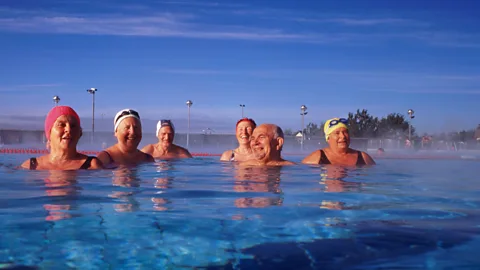
Instead of going to the pub or park, Icelanders like to gather in their local pool
The festive atmosphere outside Laugardalslaug pool was repeated around the city. The reason for the excitement was that Reykjavík’s public pools were reopening after eight weeks of closure due to the Covid-19 pandemic. The reopening had been announced a few days earlier on Facebook, where Reykjavík’s mayor, Dagur B Eggertsson, explained that the pools, which normally close between 22:00 and 06:30, would open early to ensure they could accept as many swimmers as possible while operating at half capacity, per Covid-19 precautions.
“Some people will be tired at work on Monday – but… first and foremost they’ll be clean and happy,” he wrote, adding: “See you in the pool!”
 Feifei Cui-Paoluzzo/Getty Images
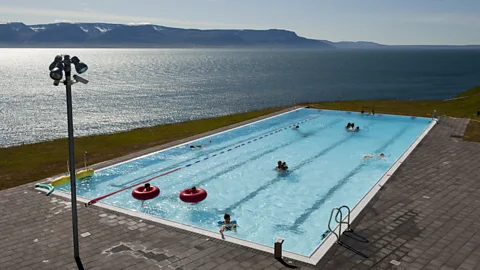
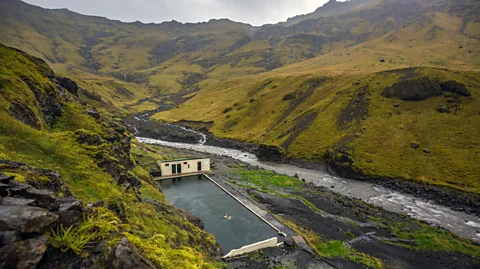
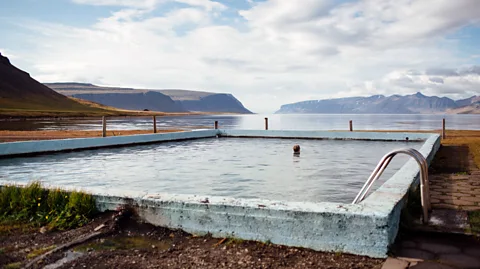
The scenes were testament to the affection Icelanders hold for their public pools. Every Icelandic town, no matter how small, has a pool, or sundlaug. Most are outdoors, heated geothermally, include a hot tub and are open year-round, allowing Icelanders to enjoy their daily swim no matter the weather.
“Lounging around in swimming pools and hot springs is a national pastime,” said filmmaker Jón Karl Helgason. “Instead of going to the pub or park, Icelanders like to gather in their local pool to get fresh air, exercise and discuss world matters in the hot tub.”
Helgason grew up accompanying his father to the local pool daily. Now he’s working on a documentary, Swimming Pool Stories, due for release in October 2020, which examines the culture of public bathing as an important feature of everyday life. It may seem odd that visiting an outdoor pool is an ingrained part of a cold-climate country’s culture, but the pool is as much a social space as a place to exercise.
“[It’s] often the focal point in an Icelandic community,” said Helgason. “Everybody uses it, from small children to the elderly and everybody in between. Many Icelanders will go to the pool daily, either on their way to or from work. Schools will use the pools for teaching swimming, while the elderly can attend water aerobics classes and enjoy a chat and a coffee afterwards.”
Filming has taken Helgason to 100 pools around Iceland, where he got to know the many different kinds of people who frequent them. “Guests come from all walks of life,” he said, “clergymen, writers, farmers, seamen, teachers, academics, labourers, politicians and celebrities.” Functioning as a meeting place for a cross-section of society can have a levelling effect, he believes; sitting in a pool semi-naked means that “all the trappings associated with class or wealth through one’s clothing are gone. Now you are who you are. Nothing more, nothing less.”
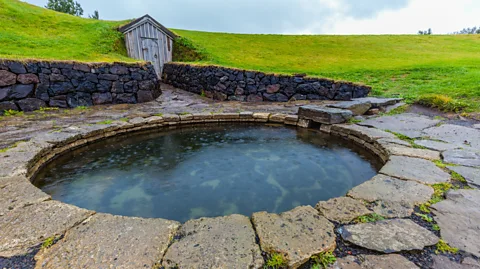
Records of public bathing in Iceland date to the 13th Century. In the west of the country, Snorralaug (Snorri’s Pool), a small circular pool used by Iceland’s most-celebrated literary figure, the saga writer Snorri Sturluson, is mentioned in Landnámabók (Book of Settlements) and Sturlunga saga. It was in the 20th Century, however, that pools became a fixture in everyday life, thanks to Iceland’s unique geology.
 Thomas H Mitchell/Getty Images
“Following an unusually cold winter of 1918, the population was severely hit by the Spanish flu,” write University of Iceland professors Örn D Jónsson and Ólafur Rastrick in their analysis of Iceland’s pools. The combination of the pandemic and rising coal prices, due to the war, “had devastating effects on the already fragile economic conditions in many families”.
To counter the cost of imported coal and oil, which had been Iceland’s primary source of heating, the volcanic island began transitioning to alternative energy by harnessing its rich resources of geothermal power, which were soon used to heat newly built swimming pools, as well as homes. Today around 65% of Iceland’s energy supply is geothermal.
The emergence of the swimming pool was dependent not only on the availability of geothermal power but also, the researchers write, “on the national significance that became associated with swimming during the formative years of the Icelandic nation state”.
 Nordicphotos/Alamy
Iceland became a sovereign state in 1918 and achieved full independence from Denmark in 1944. During this period, attitudes towards swimming changed. There had previously been little emphasis on knowing how to swim, despite living on an island surrounded by the sea. However, as Iceland transitioned from a farming economy into a fishing nation, learning to swim became viewed as essential.
Lounging around in swimming pools and hot springs is a national pastime
Since 1940, swimming lessons have been mandatory for children. “It's such a big part of our lives,” said Brá Guðmundsdóttir, human resources manager for the Laugardalslaug and nearby Sundhöllin pools. “We start swimming with our kids when they are a few months old, then all the kids start lessons when they start school.” Weekly lessons, she said, are mandatory from the age of six until 16, when everyone is tested to prove they can swim 600m unassisted.
But beyond preventing drownings, swimming was elevated in the early 20th Century for what Jónsson and Rastrick describe as its “civilising effect”. It was related to the nationalist movement, Rastrick told me, “and, most specifically, the patriotic youth movement (Ungmennafélag Íslands) that promoted swimming… as a means to develop the physique of the members of the emerging independent Icelandic nation”. The link between medieval and modern Iceland was important for the nationalist movement, he added, so this emphasis on physical improvement linked “the bodies of modern Icelandic men to the heroes of the sagas”.
In 1937, the Art Deco Sundhöllin (the “Swimming Palace”), Iceland’s oldest public baths, opened in Reykjavík, and, write Jónsson and Rastrick, “was seen as one of the most impressive symbols of the nation’s self-respect”. If the emergence of swimming in Iceland helped to foster the newly independent nation’s confidence, it’s a transformation that is repeated on a smaller scale every day in the pool as the warm water helps shed the typically reserved Icelanders’ inhibitions.
“Icelandic winters are long, cold and dark and our summers are not particularly warm either,” Helgason said. “This means we’re always heavily dressed, we drive between locations and there’s little opportunity for leisurely downtown strolls or public socialising outdoors. All of this makes for a nation that is reserved by nature. However, once we’ve stripped off those layers of clothing and entered the hot tub, we become chatty extroverts.”
That the pool fosters health in mind and body, as well a sense of equality, might be key to why Iceland regularly ranks as one of the world’s happiest countries. In his research, Jónsson asked people how they felt after visiting a pool. Almost all responded that they felt “revitalised”, in both body and soul. He added, however, that “there is very little exotic here, only a quest for comfort [that’s] affordable for everyone”.
 Amanda Richter/Getty Images
Jónsson also found that pool-goers usually don’t become close friends, “and that is probably the 'secret’ of the popularity of visiting the pools”. He describes the “thrown-togetherness” of gathering in public places as a “get-together without obligations” – much like being pleased to see fellow regulars at the local pub but without feeling the need to form deeper friendships with them.
Once we’ve stripped off those layers of clothing and entered the hot tub, we become chatty extroverts
The pool may be an essential feature of the local community, but visitors are always welcome as long as they respect etiquette. Little chlorine is used in order to maintain the purity of the water, so one of the most important rules is to first thoroughly wash, without a swimsuit, in the communal changing room. The lack of privacy can make foreign visitors uncomfortable, but it’s perhaps another example of the breaking down of barriers that the pool facilitates.
Many also talk of the positive effect of seeing “real” bodies in their imperfect flesh – a sentiment I recognise. When I lived in Iceland in the mid-2000s, unable to sleep in the bright summer light, I developed an early morning ritual of visiting the local pool. Surrounded by women of all ages and shapes, I felt the insecurities that come with being a young woman washed away in the communal shower.
Today, having effectively beaten back the virus, all restrictions have been lifted at Iceland’s beloved pools. The country is now also reopening to tourism. For those who visit, Helgason recommends a pool visit, because, he says, “there’s no better way to get in touch with the nation”.
 Alex Walker/Getty Images
Subscribe to:
Comments (Atom)