


“The unpredictable and the predetermined unfold together to make everything the way it is.”
―
Arcadia

 Posts
All Comments
Posts
All Comments
“The unpredictable and the predetermined unfold together to make everything the way it is.”
It's the best possible time of being alive, when almost everything you thought you knew is wrong.”
―
Arcadia
“The ordinary-sized stuff which is our lives, the things people
write poetry about—clouds—daffodils—waterfalls—what happens in a cup of
coffee when the cream goes in—these things are full of mystery, as
mysterious to us as the heavens were to the Greeks.”
“Words... They're innocent, neutral, precise, standing for this,
describing that, meaning the other, so if you look after them you can
build bridges across incomprehension and chaos. But when they get their
corners knocked off, they're no good any more... I don't think writers
are sacred, but words are. They deserve respect. If you get the right
ones in the right order, you can nudge the world a little or make a poem
which children will speak for you when you're dead.”
― Tom Stoppard, Rosencrantz and Guildenstern Are Dead
“We do on stage things that are supposed to happen off. Which is a
kind of integrity, if you look on every exit as being an entrance
somewhere else.”
[...] some days I wake up at 4 a.m. with an idea in my head and tiptoe into the kitchen and make coffee and sit at the keyboard and feel outrageously lucky.
Garrison Keillor from My Thanksgiving visitors The Column: 11.28.25
https://www.bbc.com/travel/article/20200817-an-icelandic-ritual-for-wellbeing
 Arctic-Images/Getty Images
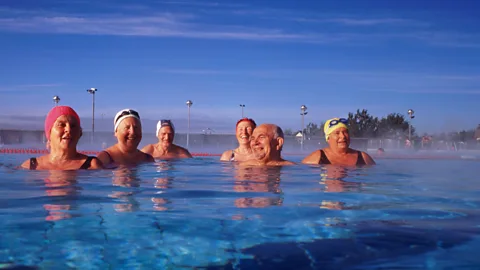
When Iceland reopened its public swimming pools after two months of closure, the nation was so delighted that queues formed outside pools at midnight.
Three months ago in the Icelandic capital of Reykjavík, hundreds of people queued outside the city’s largest swimming pool under the blueish glow of the midnight sun. As the date ticked over from Sunday 17 May to Monday 18 May, the excited crowd counted down until, at exactly 00:01, smiling staff unlocked the doors.
The festive atmosphere outside Laugardalslaug pool was repeated around the city. The reason for the excitement was that Reykjavík’s public pools were reopening after eight weeks of closure due to the Covid-19 pandemic. The reopening had been announced a few days earlier on Facebook, where Reykjavík’s mayor, Dagur B Eggertsson, explained that the pools, which normally close between 22:00 and 06:30, would open early to ensure they could accept as many swimmers as possible while operating at half capacity, per Covid-19 precautions.
“Some people will be tired at work on Monday – but… first and foremost they’ll be clean and happy,” he wrote, adding: “See you in the pool!”
 Feifei Cui-Paoluzzo/Getty Images
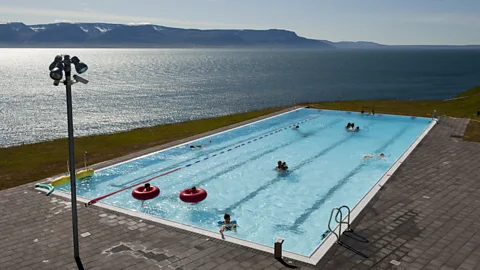
The scenes were testament to the affection Icelanders hold for their public pools. Every Icelandic town, no matter how small, has a pool, or sundlaug. Most are outdoors, heated geothermally, include a hot tub and are open year-round, allowing Icelanders to enjoy their daily swim no matter the weather.
“Lounging around in swimming pools and hot springs is a national pastime,” said filmmaker Jón Karl Helgason. “Instead of going to the pub or park, Icelanders like to gather in their local pool to get fresh air, exercise and discuss world matters in the hot tub.”
Helgason grew up accompanying his father to the local pool daily. Now he’s working on a documentary, Swimming Pool Stories, due for release in October 2020, which examines the culture of public bathing as an important feature of everyday life. It may seem odd that visiting an outdoor pool is an ingrained part of a cold-climate country’s culture, but the pool is as much a social space as a place to exercise.
“[It’s] often the focal point in an Icelandic community,” said Helgason. “Everybody uses it, from small children to the elderly and everybody in between. Many Icelanders will go to the pool daily, either on their way to or from work. Schools will use the pools for teaching swimming, while the elderly can attend water aerobics classes and enjoy a chat and a coffee afterwards.”
Filming has taken Helgason to 100 pools around Iceland, where he got to know the many different kinds of people who frequent them. “Guests come from all walks of life,” he said, “clergymen, writers, farmers, seamen, teachers, academics, labourers, politicians and celebrities.” Functioning as a meeting place for a cross-section of society can have a levelling effect, he believes; sitting in a pool semi-naked means that “all the trappings associated with class or wealth through one’s clothing are gone. Now you are who you are. Nothing more, nothing less.”
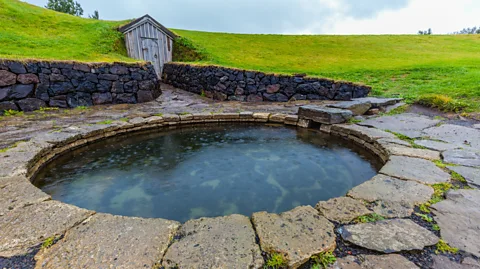
Records of public bathing in Iceland date to the 13th Century. In the west of the country, Snorralaug (Snorri’s Pool), a small circular pool used by Iceland’s most-celebrated literary figure, the saga writer Snorri Sturluson, is mentioned in Landnámabók (Book of Settlements) and Sturlunga saga. It was in the 20th Century, however, that pools became a fixture in everyday life, thanks to Iceland’s unique geology.
 Thomas H Mitchell/Getty Images
“Following an unusually cold winter of 1918, the population was severely hit by the Spanish flu,” write University of Iceland professors Örn D Jónsson and Ólafur Rastrick in their analysis of Iceland’s pools. The combination of the pandemic and rising coal prices, due to the war, “had devastating effects on the already fragile economic conditions in many families”.
To counter the cost of imported coal and oil, which had been Iceland’s primary source of heating, the volcanic island began transitioning to alternative energy by harnessing its rich resources of geothermal power, which were soon used to heat newly built swimming pools, as well as homes. Today around 65% of Iceland’s energy supply is geothermal.
The emergence of the swimming pool was dependent not only on the availability of geothermal power but also, the researchers write, “on the national significance that became associated with swimming during the formative years of the Icelandic nation state”.
 Nordicphotos/Alamy
Iceland became a sovereign state in 1918 and achieved full independence from Denmark in 1944. During this period, attitudes towards swimming changed. There had previously been little emphasis on knowing how to swim, despite living on an island surrounded by the sea. However, as Iceland transitioned from a farming economy into a fishing nation, learning to swim became viewed as essential.
Since 1940, swimming lessons have been mandatory for children. “It's such a big part of our lives,” said Brá Guðmundsdóttir, human resources manager for the Laugardalslaug and nearby Sundhöllin pools. “We start swimming with our kids when they are a few months old, then all the kids start lessons when they start school.” Weekly lessons, she said, are mandatory from the age of six until 16, when everyone is tested to prove they can swim 600m unassisted.
But beyond preventing drownings, swimming was elevated in the early 20th Century for what Jónsson and Rastrick describe as its “civilising effect”. It was related to the nationalist movement, Rastrick told me, “and, most specifically, the patriotic youth movement (Ungmennafélag Íslands) that promoted swimming… as a means to develop the physique of the members of the emerging independent Icelandic nation”. The link between medieval and modern Iceland was important for the nationalist movement, he added, so this emphasis on physical improvement linked “the bodies of modern Icelandic men to the heroes of the sagas”.
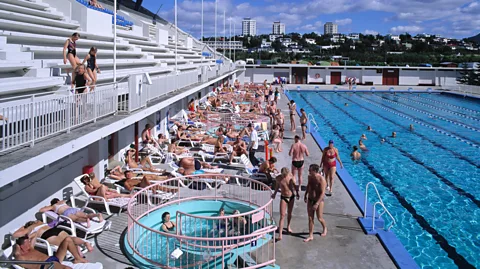
In 1937, the Art Deco Sundhöllin (the “Swimming Palace”), Iceland’s oldest public baths, opened in Reykjavík, and, write Jónsson and Rastrick, “was seen as one of the most impressive symbols of the nation’s self-respect”. If the emergence of swimming in Iceland helped to foster the newly independent nation’s confidence, it’s a transformation that is repeated on a smaller scale every day in the pool as the warm water helps shed the typically reserved Icelanders’ inhibitions.
“Icelandic winters are long, cold and dark and our summers are not particularly warm either,” Helgason said. “This means we’re always heavily dressed, we drive between locations and there’s little opportunity for leisurely downtown strolls or public socialising outdoors. All of this makes for a nation that is reserved by nature. However, once we’ve stripped off those layers of clothing and entered the hot tub, we become chatty extroverts.”
That the pool fosters health in mind and body, as well a sense of equality, might be key to why Iceland regularly ranks as one of the world’s happiest countries. In his research, Jónsson asked people how they felt after visiting a pool. Almost all responded that they felt “revitalised”, in both body and soul. He added, however, that “there is very little exotic here, only a quest for comfort [that’s] affordable for everyone”.
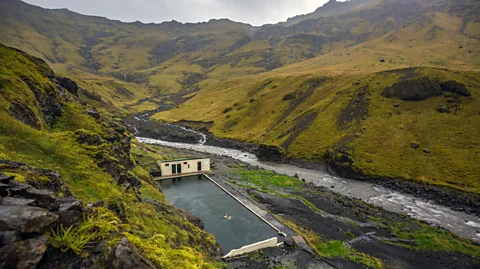 Amanda Richter/Getty Images
Jónsson also found that pool-goers usually don’t become close friends, “and that is probably the 'secret’ of the popularity of visiting the pools”. He describes the “thrown-togetherness” of gathering in public places as a “get-together without obligations” – much like being pleased to see fellow regulars at the local pub but without feeling the need to form deeper friendships with them.
The pool may be an essential feature of the local community, but visitors are always welcome as long as they respect etiquette. Little chlorine is used in order to maintain the purity of the water, so one of the most important rules is to first thoroughly wash, without a swimsuit, in the communal changing room. The lack of privacy can make foreign visitors uncomfortable, but it’s perhaps another example of the breaking down of barriers that the pool facilitates.
Many also talk of the positive effect of seeing “real” bodies in their imperfect flesh – a sentiment I recognise. When I lived in Iceland in the mid-2000s, unable to sleep in the bright summer light, I developed an early morning ritual of visiting the local pool. Surrounded by women of all ages and shapes, I felt the insecurities that come with being a young woman washed away in the communal shower.
Today, having effectively beaten back the virus, all restrictions have been lifted at Iceland’s beloved pools. The country is now also reopening to tourism. For those who visit, Helgason recommends a pool visit, because, he says, “there’s no better way to get in touch with the nation”.
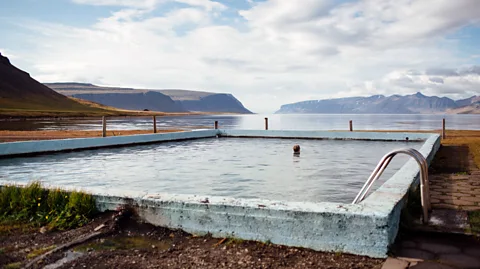 Alex Walker/Getty Images
https://plungesandiego.com/why-swimming-release-stress/
Whether you’re feeling overwhelmed from a long workweek or just need a mental reset, few things match the calming power of a swim. The rhythmic movement, weightless sensation, and steady breathing create a meditative effect that naturally soothes the nervous system. At a public pool in San Diego, where the atmosphere is relaxed and welcoming, taking a dip can quickly become your favorite way to unwind.
Unlike high-intensity workouts that leave you drained, swimming offers a peaceful balance of movement and recovery. It’s one of the few physical activities that feel just as good during the session as it does afterward.
Many swimmers describe the experience as “resetting”, almost like hitting pause on racing thoughts. The water muffles outside noise, encourages mindfulness, and even slows your heart rate when floating or gliding. Whether you’re swimming laps or simply wading in a public pool, the effect can be immediate and lasting.
Swimming triggers the release of endorphins, the body’s natural mood elevators, which are known for reducing pain and promoting a sense of well-being. These chemicals help counteract stress, ease symptoms of depression, and create a more balanced emotional state. The best part? Swimming produces this effect without putting too much strain on the body. Even a moderate swim can provide that uplifting post-exercise high, making it an ideal option for anyone looking to improve their mood while staying active.
One of the reasons swimming is so calming is its repetitive nature. The consistent strokes and deep, controlled breathing mimic the patterns used in meditation and breathing exercises. This rhythm creates a natural sense of flow that helps quiet mental chatter and brings your focus inward. Whether you’re swimming laps or gently gliding through the water, the structure of the activity helps slow down your thoughts, reduce feelings of overwhelm, and improve mental clarity.
The moment you step into a pool, your body is surrounded by gentle pressure and calming sensation. The cool temperature, the buoyancy, and the muffled sounds beneath the surface all create a unique sensory environment that promotes mental stillness. This break from noisy, overstimulating surroundings can help reduce stress and anxiety, offering a kind of sensory reset that few other activities can match. Pools in particular offer a serene space where you can step out of your routine and into a more relaxed headspace.
It’s common for stress to show up physically – stiff shoulders, a tight neck, sore back muscles. Swimming promotes fluid, low-impact movement that stretches and relaxes the entire body. The water supports your weight, allowing for full range of motion without joint strain, while the constant motion helps increase blood flow and flush out built-up tension. As your body loosens up, your mind follows suit, creating a feedback loop that leaves you feeling lighter both physically and mentally.
Unlike many forms of exercise, swimming demands a degree of mental engagement. You need to pay attention to your breathing, your form, your position in the water. That focus pulls you into the present moment, blocking out distractions like work stress, phone notifications, or tomorrow’s to-do list. In this way, swimming becomes a form of moving meditation, a time when your mind can stop spinning and just exist in the now. This kind of presence has a lasting calming effect, even after the swim is over.
I escaped a dangerous abusive and life threatening situation in my family of origin.
BLACKSTONE, Mass. – In 2017, brothers David Forgit and Kevin Miller opened Goodstuff Smokehouse on Main Street. Since then, the restaurant has had immense success and has always shared that success with its community, they say.
Every Thursday, from 4 p.m. to 9 p.m., Goodstuff donates 15 percent of proceeds to a local organization, such as the Cub Scouts, the Boys & Girls Club, or a local youth sports team.
“We’re a small company, so we have to break (fundraisers) down weekly,” Forgit said. “It allows us to spread it around more; I think every company should be doing a certain percentage of community outreach.”
The fundraisers have operated as a two-way street for Goodstuff Smokehouse, bringing positive attention and many new patrons.
“All charity essentially boils down to greed,” Forgit joked. “It’s selfish of us to do this because it brings us customers and pays dividends. When we do a fundraiser for a local softball team, Boy Scouts, church, or whatever it might be, They bring new customers and new fans.”
Yesterday a man in a Navy blue Toyota was driving out of the parking lot of Price Rite while biting into a cadmium orange persimmon.
Earlier there was man pedaling down my street carrying a bouquet of flowers with a gift tag and a huge purple ribbon. I noticed the purple ribbon come loose and fly into the street. I called out to him and pointed. He jumped off his bicycle and ran into the traffic to grab it.
This morning I saw a man with a serious expression walking in the sunshine.
“My husband, Andrius, says that evil will rule until good men or women
choose to act. I believe him. This testimony was written to create an
absolute record, to speak in a world where our voices have been
extinguished. These writing may shock or horrify you, but that is not my
intention. It is my greatest hope that the pages in this jar stir your
deepest well of human compassion. I hope they prompt you to do
something, to tell someone. Only then can we ensure that this kind of
evil is never allowed to repeat itself.”
―
Between Shades of Gray
The foundation of all else is the recognition that serious work commences in the unconscious mind, or is first received there, and is transmitted in quantities and at rates always in control of the unconscious faculties. The prime skill and discipline, therefore, is learning how to serve and thus partly master that source and governor. The discipline, as usual, divides into spiritual and physical departments.
REYNOLDS PRICE
“We are now witnessing what the historian Richard Rhodes termed ‘public man-made death,’” Gawande wrote.
"Exercise may be as beneficial as antidepressants," says researcher and medical psychologist James Blumenthal at Duke University. I would argue it's not just exercise, but exercise that burns, and thus burns out thoughts that lead to a sense of hopelessness. https://www.nextavenue.org/exercise-to-exorcise/
Society is based on ambition and conflict, and almost everyone accepts this fact as inevitable.
Krishnamurti, Commentaries on Living 2 | Read
Love is anonymous. I may love my wife and my children, but the quality of that love is anonymous. Like the sunset, love is neither yours nor mine.
Krishnamurti in New Delhi 1960, Talk 8
The self can never be anonymous; it may put on a new robe, assume a different name, but identity is its very substance. This identifying process prevents the awareness of its own nature.
Krishnamurti, Commentaries on Living 1 | Read
One can live in this world anonymously, completely unknown, without being famous, ambitious, cruel.
Krishnamurti, Think on These Things | Read
It is good to hide your brilliance under a bushel, to be anonymous, to love what you are doing and not to show off.
Krishnamurti, Think on These Things | Read
A mind that is full of conclusions is a dead mind, it is not a living mind. A living mind is a free mind, learning, never concluding.
Krishnamurti in Ojai 1973, Talk 3
The more you know yourself, the more clarity there is. Self-knowledge has no end – you don’t achieve, you don’t come to a conclusion. It is an endless river.
Krishnamurti, The First and Last Freedom | Read
If you as a human being transform yourself, you affect the consciousness of the rest of the world.
Krishnamurti in Madras 1974, Talk 1
The constant assertion of belief is an indication of fear.
Krishnamurti, The Second Krishnamurti Reader
Society is an abstraction. Abstraction is not a reality. What is reality is relationship. The relationship between human beings has created what we call society.
Krishnamurti in Bombay 1981, Talk 1
It is a waste of energy when we try to conform to a pattern. To conserve energy, we must be aware of how we dissipate energy.
Krishnamurti in London 1966, Talk 5
To live in the eternal present there must be death to the past, to memory. In this death there is timeless renewal.
Krishnamurti in Ojai 1945, Talk 10
Forget all you know about yourself; forget all you have ever thought about yourself; start as if you know nothing.
Krishnamurti, Freedom From the Known
You must understand the whole of life, not just one part of it. That is why you must read, that is why you must look at the skies, why you must sing, dance and write poems, and suffer, and understand, for all that is life.
Krishnamurti, Think on These Things | Read
How Brown University’s Pandemic Tracker is filling a gap in federal health data
People want to hear from people in their community. I do think, now, that people are very worried about the integrity of our health agencies, about funding cuts that make it harder to do the important work and research that keeps people healthy. ... The American people, despite the headlines, trust scientists, they value scientific research, and they want more of it.
https://www.bostonglobe.com/2025/07/21/metro/ri-brown-university-covid-19-pandemic-tracker/
Providing trusted, science-based information to empower individuals, families, communities, clinicians, and policymakers to make informed vaccine choices.
In the hustle and bustle of our modern lives, finding moments of peace and tranquility can be challenging. However, there is a serene oasis that offers respite from the chaos—a place where you can immerse yourself in calmness and embrace a sense of mindfulness: the water. Swimming, with its rhythmic strokes and weightless buoyancy, has the power to unlock a unique form of meditation.
Swimming can help with the meditative and calming aspects. We also explore how being in the water can promote mindfulness, stress relief, and overall mental well-being. Swimming lessons in Seminole, FL can help you achieve the list below.
The Flowing Rhythm of the Water:
Swimming provides an opportunity to embrace the flowing rhythm of the water, creating a soothing and meditative experience.
Consider the following aspects:
a. Focus on Breath: Aligning your breath with your strokes creates a rhythmic pattern that calms the mind and enhances mindfulness. Concentrate on the sensation of air entering and leaving your body, syncing it with the ebb and flow of the water.
b. Sensory Immersion: As you glide through the water, embrace the sensory experience—the gentle sound of water caressing your ears, the feel of coolness against your skin, and the weightlessness that envelops you. Immerse yourself fully in the present moment.
c. Mindful Movements: Pay close attention to your body's movements as you swim, from the extension of your arms to the propulsion of your legs. Focus on the sensations, the muscle engagement, and the symphony of motion. This mindful connection between mind and body fosters a state of tranquility.
Stress Relief and Mental Well-being:
Swimming has been known to offer numerous mental health benefits, acting as a powerful tool for stress relief and overall well-being.
Here's how swimming can help:
a. Stress Reduction: The repetitive nature of swimming, combined with the water's calming effect, can help release stress and tension. As you glide through the water, allow your worries to dissolve, and embrace a sense of calmness and serenity.
b. Mindfulness in Motion: Swimming provides a unique opportunity to practice mindfulness in motion. By focusing your attention on each stroke, you cultivate a state of present-moment awareness, leaving behind the noise and distractions of daily life.
c. Mental Clarity: The rhythm and repetitive motion of swimming can clear your mind, allowing thoughts to flow freely and providing space for new ideas and insights to emerge. It is a chance to disconnect from technology and connect with your inner self.
d. Endorphin Release: Swimming stimulates the release of endorphins, those feel-good hormones that elevate mood and promote a sense of well-being. The combination of physical activity, relaxation, and the meditative qualities of swimming contribute to a positive mental state.
Tips for a Mindful Swimming Practice:
To fully embrace the Zen of swimming and incorporate mindfulness into your aquatic journey, consider the following tips:
a. Set an Intention: Begin your swim session with a clear intention to be present and cultivate mindfulness. Leave behind distractions and fully immerse yourself in the experience.
b. Focus on Sensations: Pay attention to the physical sensations of swimming—the water's temperature, the movement of your body, and the sensation of each stroke. Engage your senses and stay anchored in the present moment.
c. Visualize and Reflect: Use your swim as an opportunity for introspection. Visualize positive affirmations or reflect on aspects of your life that you want to bring into balance. Allow the water to become a canvas for your thoughts and intentions.
d. Practice Breath Awareness: Your breath is a powerful anchor for mindfulness. Take deep and deliberate breaths.
I think this is it. This is the famous LEO'S Chocolate Pudding
recipe from Providence in the 1980's. I used to make this as a prep chef when I worked at Leo's. It was
served in small 4 ounce custard or dessert cups. You can also fill a 9"
pie pan lined with a pre-baked press-in whole-wheat oil crust. This is a
half recipe from the restaurant.
Ingredients
6 ounces of unsweetened baker's chocolate (typically sold as a 4 ounce box), broken up (or roughly-chopped)
5 tablespoons of cornstarch (1/4 cup plus one tablespoon)
1/2 cup granulated white sugar
2 cups whole milk
1/4 cup (light) Karo corn syrup
1 cup of strong (hot, drinkable) coffee
1 teaspoon vanilla (try homemade!)
1/2 teaspoon of Kosher salt
(NEW ADDITION) zest of one orange.
Directions
Mix dry ingredients (cornstarch, salt, sugar) together in a glass bowl (not the chocolate). Whisk in the whole milk, hot coffee, Karo syrup, and vanilla. Transfer to a heavy-bottomed pot and place over medium heat. Set kitchen timer for 10 minutes. Begin whisking and don't stop for 10 minutes.
When the milky cornstarch coffee vanilla liquid is hot, add the roughly-chopped unsweetened chocolate. And (optional but delicious) orange zest. Keep whisking. Have a spatula handy to keep all of the melting chocolate included. It will thicken in the 9th minute.
Pour into tiny dessert cups, 4 ounces is plenty. Enjoy warm or refrigerate. Serve as is or with whipped cream and a dusting of chocolate shavings or cocoa. WARNING: This might keep you awake at night.Most of us live in a condition of secrecy: secret desires, secret appetites, secret hatreds and relationship with the institutions which is extremely intense and uncomfortable. These are, to me, a part of the ordinary human condition. So I don't think I'm writing about abnormal things. ... Artists, in my experience, have very little center. They fake. They are not the real thing. They are spies. I am no exception.
JOHN LE CARRÉ
In the Gilded Age 2.0, the rich aren’t just different — they’re intolerable
The ultrawealthy used to leave legacies. Now they leave middle fingers.
https://www.bostonglobe.com/2025/11/21/opinion/wealthy-intolerable-spend-money/
Boston Globe
My favorite Thanksgiving recipe: Reading poems
These verses have enriched the holiday for my family. Maybe they’ll speak to yours, too.
Daryln Brewer Hoffstot is the author of a collection of essays, “A Farm Life: Observations From Fields and Forests.”
My husband loves all the trimmings of Thanksgiving, particularly mashed potatoes. I adore my grandmother’s recipe for Mamie Eisenhower’s Pumpkin Chiffon Pie. But I could skip the traditional meal entirely and be perfectly happy eating takeout, because my favorite part of the holiday is the poetry that we read aloud around the table.
This is not an old tradition for us. I grew up in suburban New York with parents who loved the New York Giants. Thanksgiving was a typical American meal with football on TV, hoots and hollers from the den, family members rooting for opposite sides. No one thought about poetry.
But as an adult with a family of my own, I began to imagine other ways to celebrate the holiday. And what better way than to pause for a few minutes to listen to poets who remind us to be grateful for so much: for one another; for the comfort of our lives compared to many; for love and justice; for children, music, and gardens; for the nature and animals that surround us; and for no wars … here, at least, at the moment.
Robert Louis Stevenson has welcomed us to the table: “Lord behold our family here assembled / We thank Thee for this place in which we dwell / For the love that unites us / For the peace accorded us this day.
Maya Angelou has dined with us, too: “My wish for you / is that you continue / To remind the people that / Each is as good as the other / And that no one is beneath / Nor above you.”
We’ve read Czeslaw Milosz’s “Gift:” “A day so happy / Fog lifted early, I worked in the garden. / Hummingbirds were stopping over honeysuckle flowers. / There was no thing on earth I wanted to possess.”
And Naomi Shihab Nye, who wrote about kindness: “Before you learn the tender gravity of kindness / you must travel where the Indian in a white poncho / lies dead by the side of the road. / You must see how this could be you, / how he too was someone / who journeyed through the night with plans / and the simple breath that kept him alive.”
We read poems after dinner and during dessert. Sometimes just the family is present; at other times we’ve had larger gatherings with friends. No one has ever said no when I’ve requested he or she bring a poem to read. Everyone reads with passion and a strong voice. Some have written their own poems, others have read classics, and there are poems we’ve never heard before.
Elizabeth Bishop, Shakespeare, W.S. Merwin, and Mary Oliver have graced our table, as well as William Martin, who has reminded us not to push our children so hard: “Do not ask your children / to strive for extraordinary lives. / Such striving may be admirable / But it is the way of foolishness. / Help them instead to find the wonder / and the marvel of an ordinary life.”
During COVID-19, I read Pablo Neruda’s “Keeping Still”: “Now we count to twelve / and let’s keep quiet / For once on earth / let’s not talk in any language; let’s stop for one second, / and not move our arms so much. / A moment like that would smell sweet, no hurry, no engines, all of us at the same time / in need of rest.”
There was Joy Harjo’s “For Calling the Spirit Back From Wandering the Earth in Its Human Feet”: “Be respectful of the small insects, birds and animal people who accompany you. / Ask their forgiveness for the harm we humans have brought down upon them.”
And Ralph Waldo Emerson: “Write it on your heart / that every day is the best day in the year. / He is rich who owns the day, and no one owns the day / who allows it to be invaded with fret and anxiety.”
Who wouldn’t welcome Wendell Berry to their feast? In his poem “The Peace of Wild Things,” when he wakes in the night feeling despair, he recalls the healing power of nature: “In fear of what my life and my children’s lives may be, / I go and lie down where the wood drake / rests in his beauty on the water, and the great heron feeds. / I come into the peace of wild things.”
Last year, our daughter went to her boyfriend’s aunt’s house outside Boston for the holiday. Before they arrived, the aunt emailed me and asked such a thoughtful and welcoming question: What are your Thanksgiving traditions? She wanted to surprise our daughter, to make her feel at home.
“We read poems,” I said.
And so they did.
https://www.bostonglobe.com/2025/11/23/opinion/poems-to-read-on-thanksgiving/
(excerpt)
Sunlight,
filtering through bare trees,
stains the bird a dark blue
that slips to black
like secret ink and makes sense
only as his feathers move.
Joseph Green from The Business of Crows (poem)
in his book What Water Does at a Time Like This
You don’t need anyone else’s permission to be happy, to pursue your passions, express yourself more, or to live the life you’ve always dreamed of. The only permission you need is your own. Mel Robbins
A nutritious breakfast can provide long-lasting energy and keep you full for hours. A good breakfast is typically high in fiber, protein, healthy fats, and micronutrients. A nutritious breakfast can give you a good start to the day and may help prevent snacking.
Eggs provide protein, which is essential for muscle growth and maintenance. It can also keep you feeling full.
In a 2020 study, people who had eggs and toast for breakfast reported significantly less hunger than those who had bran cereal with milk and orange juice, suggesting a higher protein intake (25 grams versus 11 grams) may promote greater fullness.
The egg group also ate fewer calories at lunch, suggesting that eggs support satiety, or the feeling of being full.
Eggs also contain:
- lutein and zeaxanthin in the yolk, antioxidants that appear to support eye health and may have benefits for skin, liver, eye, and cardiovascular health
- choline, a vital nutrient for brain and liver health
- B vitamins, including folate
- vitamin A
- iron, calcium, and other essential minerals
Research from 2021 indicates that, in contrast with previous beliefs, there is no direct evidence that eggs raise cholesterol levels in most people, despite their high cholesterol content. Some evidence suggests they may have a mild protective effect against heart disease.
Eat eggs with other nutritious foods, such as whole grain toast, whole fruit, or sautéed vegetables.
Traditionally, Matt and I get Chinese takeout for Thanksgiving, a holiday I actively dislike. Despite its name, Thanksgiving is really the Family Holiday. Even Christmas pales beside it: that day's focus is on giving and receiving even more than togetherness. Strangely though, being alone on Christmas is to be almost hauntingly empty; you feel like a ghost. But being alone on Thanksgiving is rather wonderful, like not attending a party that you didn't want to go to and where no one will realize you're not there. At Thanksgiving, you gather with your family and stuff yourself with food as if it were love—or the next best thing —then stagger back to your regular life, oversatiated and wrung out. Christmas, however, creates expectations that are never met, so you leave hungry and depressed, with an armload of things you didn't want and can't imagine why anyone would think you did.
When the family of origin is unsafe, it can involve physical, emotional, or sexual abuse, neglect, or the presence of issues like addiction or mental illness, leading to long-term impacts on an individual's sense of self, relationships, and mental health.
Such environments can foster patterns like difficulty with trust, poor boundaries, fear, anxiety, and challenges with emotional regulation. Seeking professional help through therapy can provide a space to address these issues, understand their origins, and develop healthier coping mechanisms
Signs of an unsafe family of origin
- Abuse or neglect: Physical, emotional, or sexual abuse, and physical or emotional neglect are all forms of an unsafe family environment.
- Family member issues: Having a parent or close family member with a mental illness or substance abuse problem can create an unpredictable and unsafe dynamic.
- Conflict and trauma: Witnessing domestic violence, experiencing frequent conflict, or dealing with separation or incarceration of a family member can be detrimental.
- Emotional and psychological harm: Emotions may be mocked, dismissed, or not allowed to be expressed. There can be a lack of accountability, with frequent apologies being rare or nonexistent.
Potential long-term effects
- Relationship difficulties: Trouble with trust, forming healthy connections, fear of commitment, and codependency can arise.
- Mental and emotional health issues: Anxiety, depression, low self-esteem, and a sense of shame are common consequences.
- Behavioral patterns: You might find yourself trying to prove yourself, being overly defensive, or exhibiting disproportionate emotional reactions. Other patterns include perfectionism, poor boundaries, and insecure attachment styles.
- Identity struggles: An unsafe family of origin can hurt your sense of identity and self-worth, leading you to internalize negative beliefs about yourself.
How to cope and heal
- Seek professional therapy: A therapist can help you safely explore distressing memories, understand how past experiences influence your present, and develop new coping strategies.
- Learn about family patterns: Therapies like Family Systems Therapy or genogram work can help you map and understand the patterns passed down from your family.
- Set boundaries: Learning to set and maintain boundaries is crucial, especially if you choose to remain in contact with family members.
- Connect with supportive people: Finding a new, supportive community or social group can provide a positive influence and a sense of belonging.
- Practice self-compassion: Be patient with yourself as you work through these challenges. Healing from family trauma is a process.
If you grew up in a family with a chemically dependent, mentally ill, or abusive parent, you know how hard it is — and you know that everyone in the family is affected. Over time, the family begins to revolve around maintaining the status quo the dysfunction.
Rigid family rules and roles develop in dysfunctional families that help maintain the dysfunctional family system and allow the addict to keep using or the abuser to keep abusing.
Why do teachers become teachers? The answer is different for everyone, but for most, it is because teaching is about changing lives. Every day, teachers guide students through critical stages of development, equipping them with the knowledge, skills and confidence they need to thrive.
As a teacher, you are a change agent. You don’t just deliver lessons, you open minds, build self-belief and create safe spaces where students can grow. You may be the person who helps a student discover their passion, overcome a challenge or believe in themselves for the first time and that kind of impact stays with a person for life.
Caldo verde means "green soup," so if you aren't cooking your kale long enough to turn the soup green, you ain't making caldo verde!
Swimming changed my life and now I am teaching other adults how to enjoy swimming at the Franklin MA Hockomock YMCA. It's a beautiful feeling to inspire others and this YMCA is fabulous because of the good vibes. My students want to learn and they learn fast.
The Investment by Robert Frost
Nobody can teach you about yourself except yourself, so you have to be the guru and the disciple yourself, and learn from yourself. What you learn from another is not true.
Krishnamurti at Madras 1971, Talk 3
To be free of all authority, your own and that of another, is to die to everything of yesterday, so that your mind is fresh, young, innocent, full of vigour and passion.
Krishnamurti, Freedom From the Known
To be aware means to be sensitive, alive to the things about one, to nature, to people, to colour, to trees, to the environment, to the social structure, the whole thing; to be aware outwardly of all that’s happening and to be aware of what is happening inside.
Krishnamurti at Brockwood Park 1977, Discussion 2
https://kfoundation.org/the-whole-movement-of-life-is-learning-chapter-48/
Of course, the authoritarian attitude destroys all intelligence. The sense of obedience breeds only fear which in itself inevitably drives away the understanding of the true nature of intelligence. So what place has authority in a school? We have to study authority, not merely assert that there should be no authority but only freedom. We have to study it as we study the atom. The structure of the atom is orderly. Obedience, following, accepting authority, whether it is blind or clear-eyed, must inevitably bring about disorder. What is the root of obedience, which breeds authority? When one is in disorder, confusion, society becomes utterly chaotic; then that very disorder creates authority, as has happened so often historically. Is fear the root of accepting authority, being uncertain, without clarity in oneself,? Then each human being helps to bring about the authority that will tell us what to do, as has happened in all religions, all sects and communities. It is the everlasting problem of the guru and the disciple, each destroying the other. The follower then becomes the leader. This cycle is forever repeating itself. Krishnamurti
I was first turned on to Krishnamurti in my 20's and the top of my head blew off. I still love his writings.
Have a peek.
Your own self-realization is the greatest service you can render the world.
Let what comes come. Let what goes go. Find out what remains.
The best way for one to serve the world is to win the egoless state.
If one’s mind has peace, the whole world will appear peaceful.
As you are, so is the world. Ramana Maharshi
The hardest thing about writing, in a sense, is not writing. I mean, the sentence is not intended to show you off, you know. It is not supposed to be “look at me!” “Look, no hands!” It’s supposed to be a pipeline between the reader and you. One condition of the sentence is to write so well that no one notices that you’re writing. James Baldwin
“What can you do. You get a name, you're called 'Thomas Bernhard', and
it stays that way for the rest of your life. And if at some point you go
for a walk in the woods, and someone takes a photo of you, then for the
next eighty years you're always walking in the woods. There's nothing
you can do about it.”
―


