
 Posts
Posts


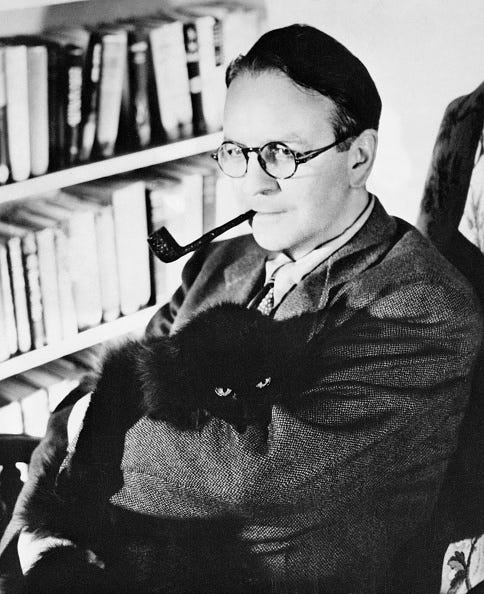
And it’s the birthday of crime novelist Raymond Chandler, born in Chicago (1888). He wrote seven novels featuring detective Philip Marlowe, including The Big Sleep (1939), Farewell, My Lovely (1940), The Little Sister (1949), and The Long Goodbye (1954). He also wrote screenplays, including such film noir classics as Double Indemnity (1944), The Blue Dahlia (1946), and Strangers on a Train (1951).
Though he was born in Chicago, Chandler grew up in England and Ireland. His parents divorced, and he and his mother moved to London in 1895; her brother, a lawyer, supported them. Chandler went to a prestigious prep school and had dreams of becoming a lawyer, but his uncle couldn’t or wouldn’t pay for his education. So Chandler went to work to support the family, and in his spare time he wrote poetry, which he later described “B-grade.” He managed to publish 27 of his poems, though, as well as a short story called “The Rose-Leaf Romance.” He returned to the United States in 1912; one of his fellow passengers on the ship from England suggested he try California, so Chandler settled in Los Angeles, where he took a series of odd jobs like stringing tennis rackets, picking fruit, and keeping the books for a creamery. He joined the Canadian army during World War I and served on the front lines in France. After the war, he returned to California, married a woman 18 years his senior, and took a job as a bookkeeper for an oil company. Eventually, he worked his way up to vice president of the company.
The Great Depression, job stress, and his wife’s failing health all took a toll on Chandler. He started drinking heavily, and philandering. When he was fired from the oil company in 1932, he started writing again. He decided the best way to make a quick buck would be to write pulp fiction. He wasn’t great at coming up with plots, so he studied stories in detective magazines and tinkered with their plots to come up with his own. But his writing was top-notch; when he sold his first story — the 18,000-word “Blackmailers Don’t Shoot” — it was so polished and flawless that editors congratulated themselves on their discovery of the next literary genius. He published 26 short stories in all, and with similar attention to detail. When he broke the rules of grammar, he did so consciously, as he wrote to the editor of Atlantic Monthly: “By the way, would you convey my compliments to the purist who reads your proofs and tell him or her that I write in a sort of broken-down patois which is something like the way a Swiss-waiter talks, and that when I split an infinitive, God damn it, I split it so it will remain split, and when I interrupt the velvety smoothness of my more or less literate syntax with a few sudden words of barroom vernacular, this is done with the eyes wide open and the mind relaxed and attentive. The method may not be perfect, but it is all I have.”
He wrote his first novel in three months. That was The Big Sleep (1939), and it was made into a classic of film noir, starring Humphrey Bogart and Lauren Bacall, in 1946. William Faulkner co-wrote the screenplay. The Big Sleep introduced readers to the gumshoe hero Philip Marlowe. Chandler described him as “a complete man and a common man and yet an unusual man. He must be, to use a rather weathered phrase, a man of honor — by instinct, by inevitability, without thought of it and certainly without saying it. He must be the best man in his world and good enough for any world. I do not care much about his private life; he is neither a eunuch nor a satyr; I think he might seduce a duchess and I am quite sure he would not spoil a virgin; if he is a man of honor in one thing, he is that in all things.”
 |


No comments:
Post a Comment